Over 60% of emissions come from everyday decisions.
Transport, diet, and home energy choices made in ordinary moments account for the majority of individual carbon impact — yet no tool intervenes at the right time.
SAVE tracks habits across food, travel, shopping, and energy use, then gives timely, personalised suggestions to support lower-impact choices. For individuals, it builds awareness and encourages everyday progress. For organisations, it provides anonymised insights and engagement tools to turn sustainability goals into measurable habit change. All routine analysis runs on-device, so personal data stays on the phone.
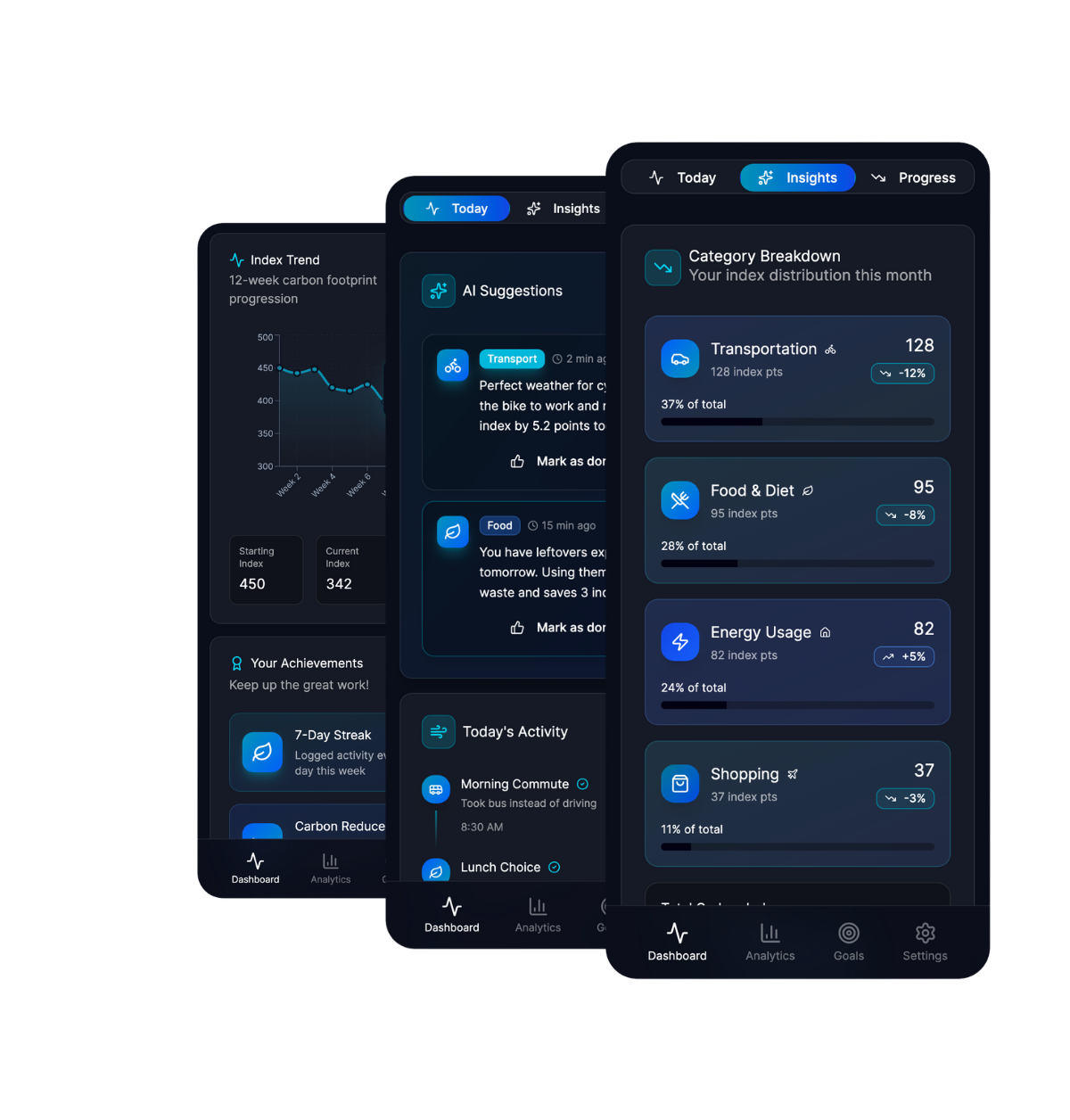
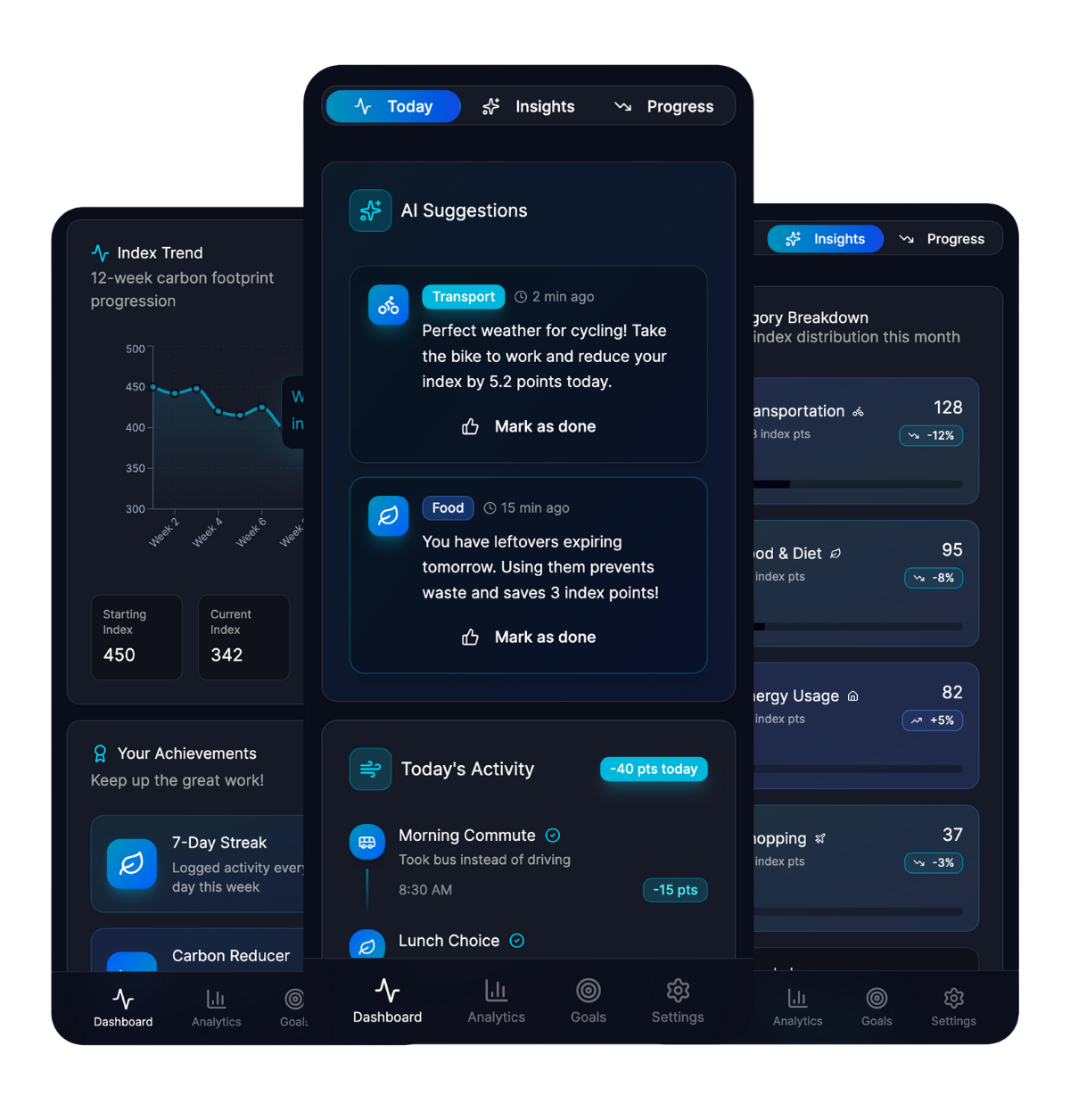
People care about climate impact, but current tools feel overwhelming, impersonal, and difficult to turn into daily behavior change.
Transport, diet, and home energy choices made in ordinary moments account for the majority of individual carbon impact — yet no tool intervenes at the right time.
Carbon footprints are shaped by repeated daily habits and routine decisions that are easy to miss.
Existing solutions often provide broad advice rather than practical hints adapted to a specific lifestyle.
Many solutions depend on uploading detailed location trails to cloud services, which creates avoidable exposure and weakens user trust over time.
Many tools require heavy manual effort and introduce privacy risks or user experience complexity.
SAVE identifies avoidable emissions and delivers small, personalized recommendations that fit naturally into each user's routine, with core learning designed to run on-device.
SAVE turns awareness into daily action with a privacy-preserving loop: learn routine patterns locally, generate context-aware recommendations, and track progress over time. Instead of complex dashboards, users get timely, practical nudges that are useful without exposing personal data.
Get started quickly without long setup or complex forms. SAVE fits into your existing routine instead of demanding a new one.
Recommendations are tailored to your habits, schedule, and context—so they’re practical and easier to act on.
See your own progress over time and, when relevant, how it contributes to broader impact—so change feels visible and meaningful.
Routine learning and context-aware recommendations can work without sending personal data to the cloud, using on-device processing and derived signals.
On-device routine learning can detect everyday patterns without demanding constant manual input.
Micro-recommendations are context-aware and practical, designed for each person’s real environment and habits.
Users can see their own progress build week by week, turning small actions into lasting low-impact habits.
Personalized, low-friction guidance in three steps
SAVE can learn from routines and daily habits on-device to understand where avoidable emissions appear.


SAVE can learn from routines and daily habits on-device to understand where avoidable emissions appear.
The app identifies high-emission habits, such as frequent short car trips and inefficient errands.


The app identifies high-emission habits, such as frequent short car trips and inefficient errands.
SAVE suggests personalized, practical actions that fit your lifestyle so small daily changes become measurable CO2 reductions.
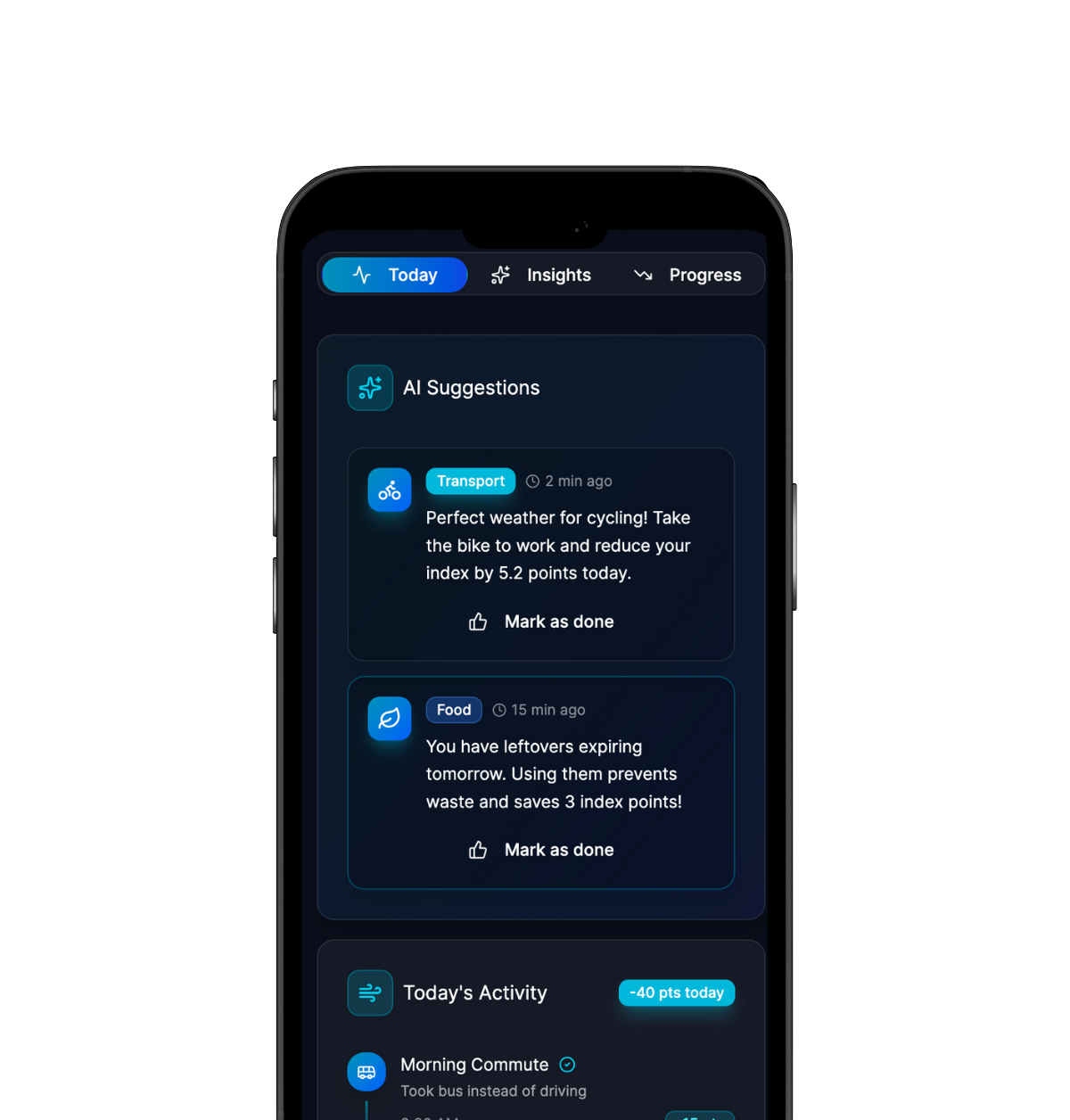

SAVE suggests personalized, practical actions that fit your lifestyle so small daily changes become measurable CO2 reductions.

SAVE can deliver routine learning and context-aware recommendations without sending any personal data to the cloud. Core analysis can run on-device, so raw movement history stays on the phone while the app generates privacy-preserving signals that power predictions and micro-recommendations.
Read how SAVE measures and stores your data →
Routine detection and pattern analysis can run locally on your phone.
Precise location trails don't need to be uploaded to external AI services to work.
Processing stays limited to what's required for useful, practical recommendations.
The system can rely on derived insights — routine patterns and likely next moments — instead of exposing detailed logs.

Instead of generic tips, SAVE is designed to use on-device ML models and privacy-preserving signals to deliver guidance that is personal, measurable, and repeatable.
SAVE will detect repeat routines through on-device pattern analysis and clustering, then build a simple model of your weekly movement.
SAVE will use prediction models on derived signals to spot what's likely coming next and when a change will have the biggest CO₂ impact, before you decide.
SAVE will use context-aware ranking to choose the easiest low-CO₂ action for your moment, based on time, place, weather, and past behavior, without exposing detailed raw logs.
Hint (the night before):
"Tomorrow looks clear. Want to take public transport to work instead of driving? It's an easy CO2 win."
Follow-up (after commute):
"Nice, today's commute was lower CO2. You're building a streak: 2/5 low-CO2 commutes this week."
SAVE did:
Hint:
"Family weekend idea: choose a nearby nature spot and go by train/bus, then walk. Fun day, much lower CO2 than a long drive."
SAVE did:
Hint:
"You've got a property visit coming up. On the way back, do your grocery run near that route, one combined trip instead of two cuts CO2."
SAVE did:
Hint (before the shop):
"Grocery tip: pick more plant-based options and seasonal products, lower CO2 than your usual basket."
Hint (after):
"Snap a photo of the receipt and I'll track your purchases and your CO2 progress over time."
SAVE did:
Hint:
"Clear weather this Thursday makes it a strong No Car Day for your teams. Launch a one-day commute challenge and promote transit-first routes."
Organization Tier dashboard highlight:
"Live dashboard shows participation by team/location, low-CO2 commute share, and campaign lift versus baseline."
SAVE did:
SAVE is built on a dual-access model: empowering individuals to change their habits for free, while providing organizations with the professional tools needed to drive and measure large-scale climate action.
Our public app provides the transparency needed to reduce avoidable emissions. It is a personal coach for sustainable travel, available to everyone, everywhere. Open access to track habits, reduce personal emissions, and visualize your journey toward a smaller footprint.
Organizations can activate SAVE across employees, members, customers, or tenants with an enterprise layer built for scale. Beyond short-term campaigns, this is a long-term behavior investment: as people learn their impact and build better routines, results compound over time.
Unlike one-off CO₂ compensation spend, SAVE creates ongoing operational value through sustained participation, measurable progress, and repeatable reduction patterns.
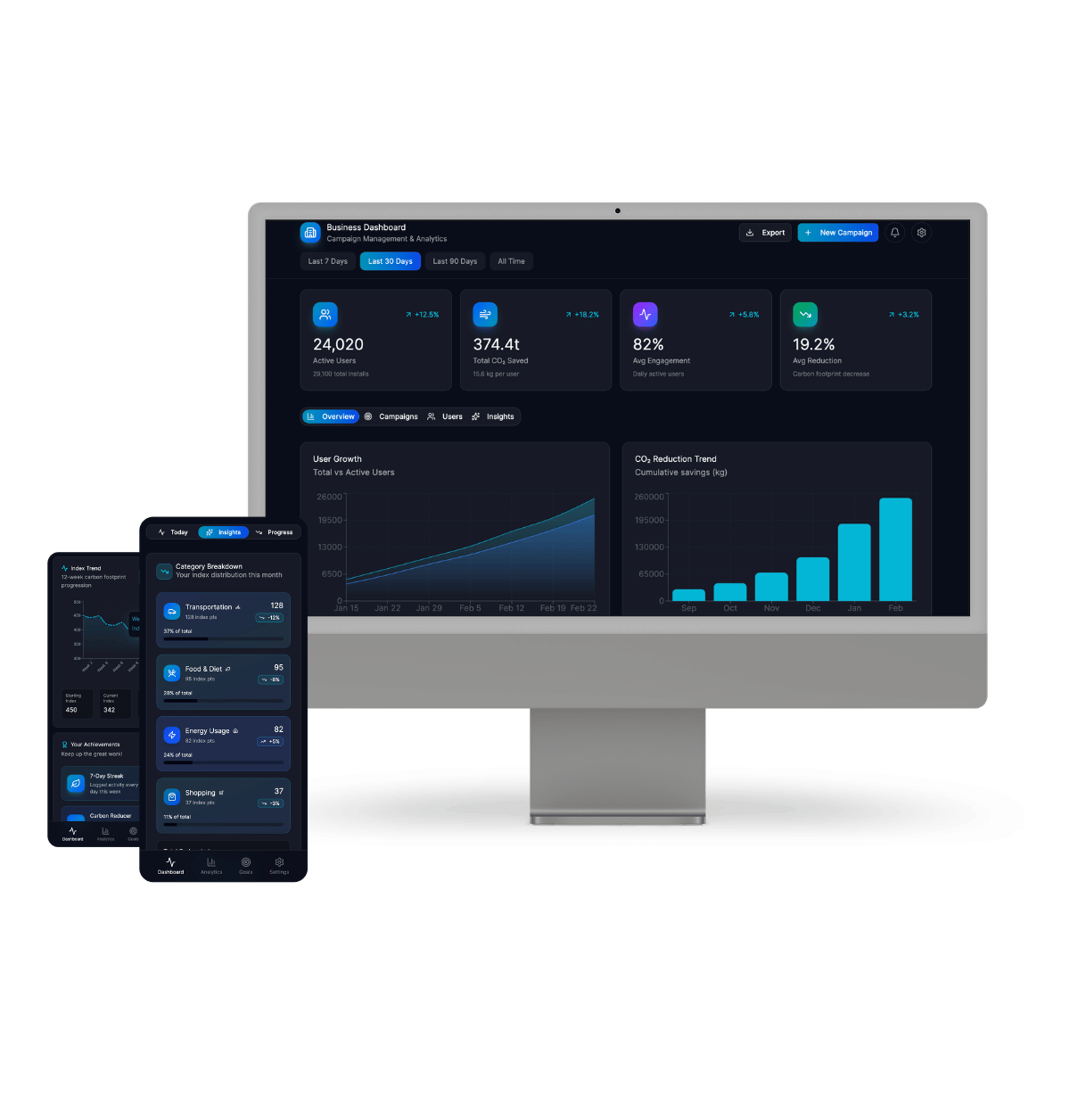
Organizations get premium capabilities including dashboard monitoring, campaign controls, organization-wide analytics, role-based access, branding options, and system integrations.
SAVE is being developed in collaboration with GT4T and SAMK Venture Science Center — working alongside mentors, researchers, and innovators across five EU regions since the project's earliest stages.

A Europe-wide initiative uniting universities, innovators, and entrepreneurs to turn research into real-world solutions — driving sustainability, digital transformation, and deep-tech growth across Europe.
GT4T has mentored SAVE since its earliest stages, connecting the project to its network spanning five EU regions: Finland, Germany, Ireland, the Netherlands, and Türkiye.
Visit GT4TGT4T is supported by the EIT HEI Initiative, and guided and co-funded by EIT Climate-KIC.


.png)
An interdisciplinary innovation hub at Satakunta University of Applied Sciences, where ideas are developed into concrete outcomes through cross-institutional collaboration, entrepreneurship, and research.
Part of the GT4T project, the center connects SAVE to a network of students, researchers, and faculty — as well as international partners through the DIVERSE University Alliance.
Visit SAMKApproximately 60% of global greenhouse gas emissions are attributable to household consumption — food, housing, and transport decisions made every day. The science is clear on where the leverage is.
of global GHG emissions trace back to household consumption — not industry alone, but the accumulated weight of everyday choices.
of non-CO₂ household emissions come from food consumption alone — methane, nitrous oxide, and F-gases that are invisible in standard carbon calculators.
of total household emissions are non-CO₂ gases — a quarter of the problem that most climate tools and policies still overlook entirely.
Xie et al. (2023). The characteristics and driving factors of household CO₂ and non-CO₂ emissions. Ecological Economics, 213.
If you care about sustainable living and want a say in how this is built, this survey is for you. It takes 5 minutes, requires no sign-in, and is completely anonymous.