Over 60% of emissions come from everyday decisions.
Transport, diet, and home energy choices made in ordinary moments account for the majority of individual carbon impact — yet most tools only show a total after the fact.
Beta on Android and iPhone — invites open
SAVE rewards lower-carbon everyday choices with Green Points, suggests realistic swaps, and measures your progress against your own starting point — not a generic average. It is not a CO2 calculator.
Free · Android and iPhone · We'll email your invite
Running a program for your organization? See SAVE for organizations
People care about climate impact, but current tools feel overwhelming, impersonal, and difficult to turn into daily behavior change.
Transport, diet, and home energy choices made in ordinary moments account for the majority of individual carbon impact — yet most tools only show a total after the fact.
Carbon footprints are shaped by repeated daily habits and routine decisions that are easy to miss.
Existing solutions often provide broad advice rather than practical hints adapted to a specific lifestyle.
Many solutions depend on uploading detailed location trails to cloud services, which creates avoidable exposure and weakens user trust over time.
Many tools require heavy manual effort and introduce privacy risks or user experience complexity.
More than 60% of global greenhouse gas emissions are linked to household consumption — the food, housing and transport choices we make every day. That's where the leverage is.
60%
of global greenhouse gas emissions are linked to household consumption (Ivanova et al., 2016).
48%
of households' non-CO₂ emissions came from food in a study of households in China — methane and nitrous oxide that CO₂-only calculators miss (Xie et al., 2023).
27%
of those households' total emissions were non-CO₂ gases — a large share that CO₂-only tracking leaves out (Xie et al., 2023).
Ivanova, D. et al. (2016). Environmental impact assessment of household consumption. Journal of Industrial Ecology, 20(3), 526–536.
Xie, R. et al. (2023). The characteristics and driving factors of household CO₂ and non-CO₂ emissions in China. Ecological Economics, 213.
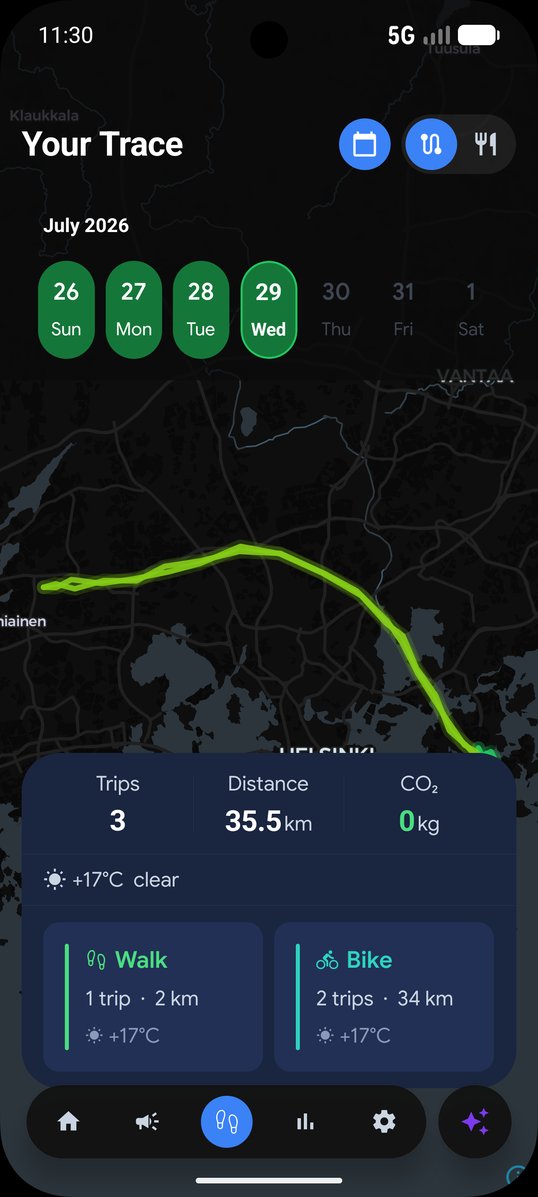
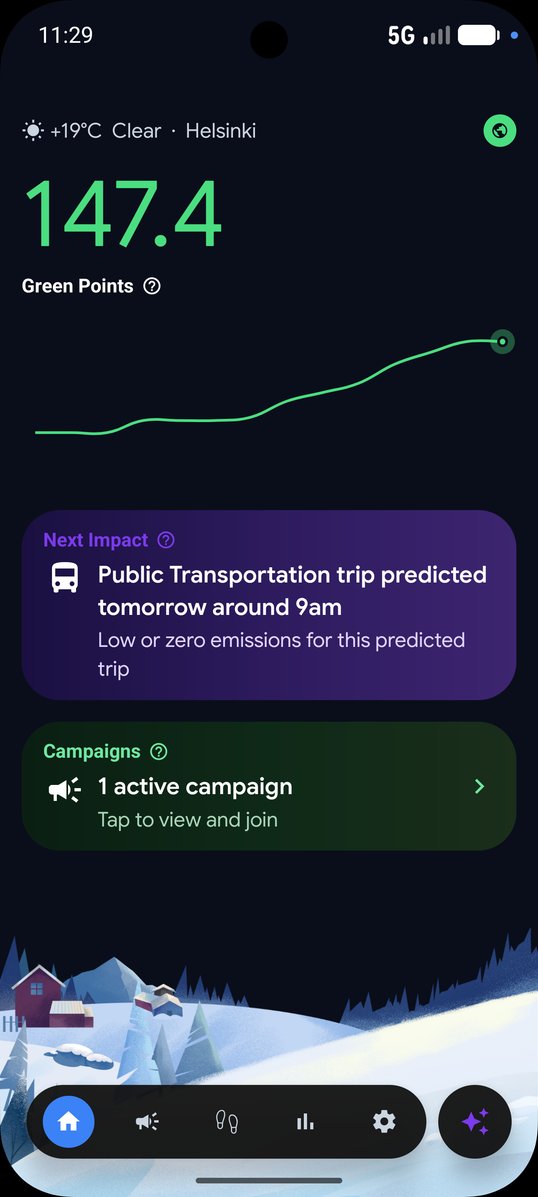
All screenshots are taken from the app in development.
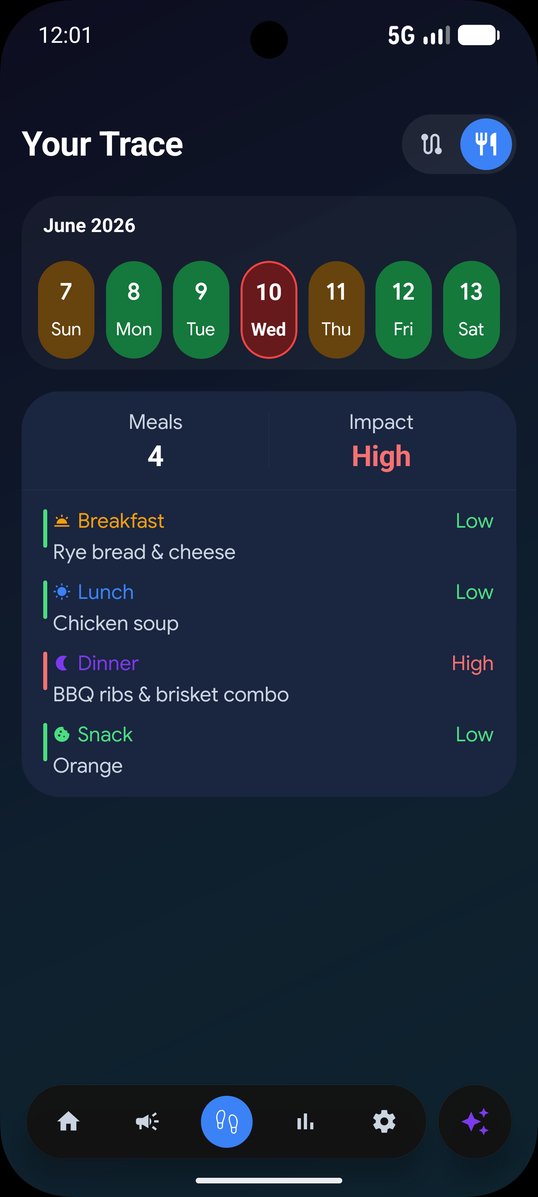
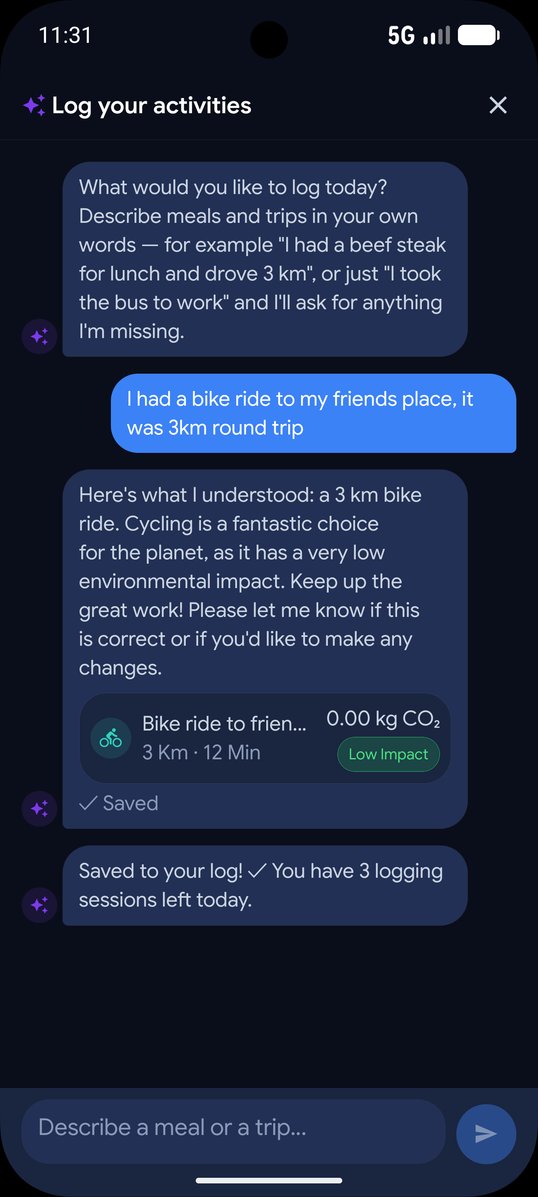
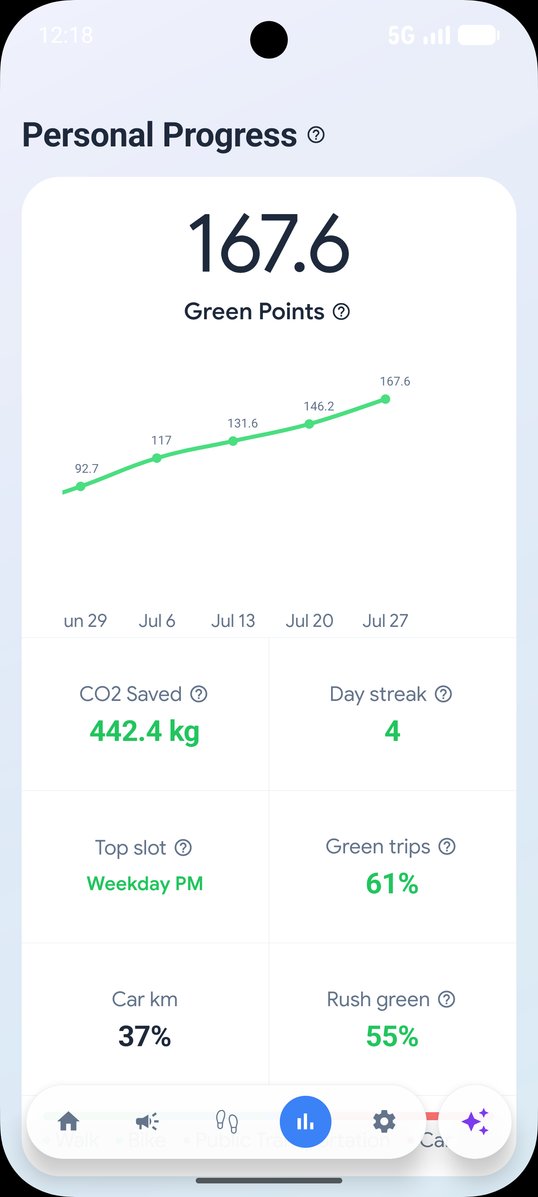
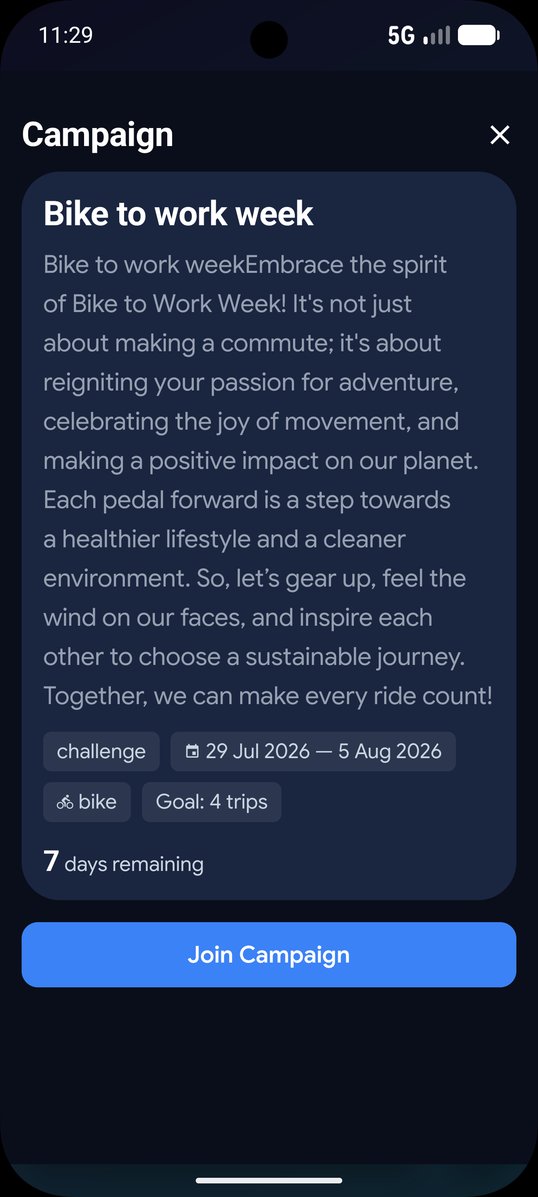
Instead of generic tips, SAVE uses machine learning on your own travel history to give guidance that is personal, measurable and repeatable.
Journeys are recorded as you go, with distance and travel mode — no diary to fill in.
A model learns when and how you usually travel, so it knows which trips are likely coming up in your week.
A second model judges whether a lower-carbon option is realistic — like cycling a short trip you usually drive — before suggesting it.
Type what you ate or how you traveled. A language model turns your sentence into an entry for you to confirm — it reads your wording; it never decides your points.
SAVE focuses on three high-impact parts of everyday life: how you get around, what you eat and what you buy. The app turns those repeated choices into simple impact signals, then uses your own history as the baseline for progress.
Trips are classified by mode and distance, so the app can estimate which routines are lower-impact and which ones are worth changing.
Meals are grouped into impact levels based on their ingredients, giving people useful food guidance without pretending to know an exact footprint for every plate.
Fewer shop trips than your usual earn points, and so does buying second-hand, repaired or borrowed. Shops are recognised on your phone; which shop is never stored.
SAVE measures progress against your own starting point, so improvement is based on your habits rather than a generic average.
SAVE needs your journeys to be useful, so we keep them where they belong: on your phone. Our servers only keep what's needed to run your account.
Yes. The SAVE app is free for individuals.
Android and iPhone. While SAVE is in beta, Android phones install it through Google Play's testing program and iPhones through Apple's TestFlight app.
Join the beta with your email. We send you an invitation with the install link for your phone — Google Play on Android, TestFlight on iPhone — and the invitation code you enter when you create your account.
Automatic journey tracking needs your location, including in the background, because most journeys happen with your phone in your pocket. You can say no and log journeys yourself instead.
Your activity history is stored only on your phone and is deleted when you uninstall the app. You can also delete your account at any time.
No. The app works on its own. Organizations can add campaigns for their people on top — see SAVE for organizations.
No. SAVE is not a CO2 calculator. It rewards lower-carbon choices with Green Points, measured against your own routine: walking, cycling and public transport, lower-impact meals, and buying second-hand, repaired or borrowed. Which choices count as lower-impact comes from standard emissions factors for travel and peer-reviewed food data. AI decides what to suggest and reads what you type — it never decides your points.
Collect Green Points for the lower-carbon habits that fit your week. Free, and your journeys stay on your phone.
Developed by LessTrace, co-founded by software architect Behzad Savabi, and mentored by GreenTech4 Transformation (GT4T), a program co-funded by EIT Climate-KIC. Meet the team
These are the kinds of hints we're designing. Some rely on features still in development, such as weather and calendar awareness.
Hint (the night before):
"Tomorrow looks clear. Want to take public transport to work instead of driving? It's an easy win for your Green Points."
Follow-up (after commute):
"Nice — today's commute earned Green Points. You're building a streak: 2 of 5 greener commutes this week."
SAVE did:
Hint:
"Family weekend idea: choose a nearby nature spot and go by train/bus, then walk. Fun day, and it earns Green Points a long drive would not."
SAVE did:
Hint:
"You've got a property visit coming up. On the way back, do your grocery run near that route, one combined trip instead of two."
SAVE did:
Hint (before the shop):
"Grocery tip: pick more plant-based options and seasonal products — a lighter basket earns Green Points."
Hint (after):
"Tell me what you bought in a sentence and I'll log it — second-hand and repaired finds earn Green Points too."
SAVE did: